
By Dr. Shiv Kumar Goel, MD – Internal Medicine, Functional & Aesthetic Medicine
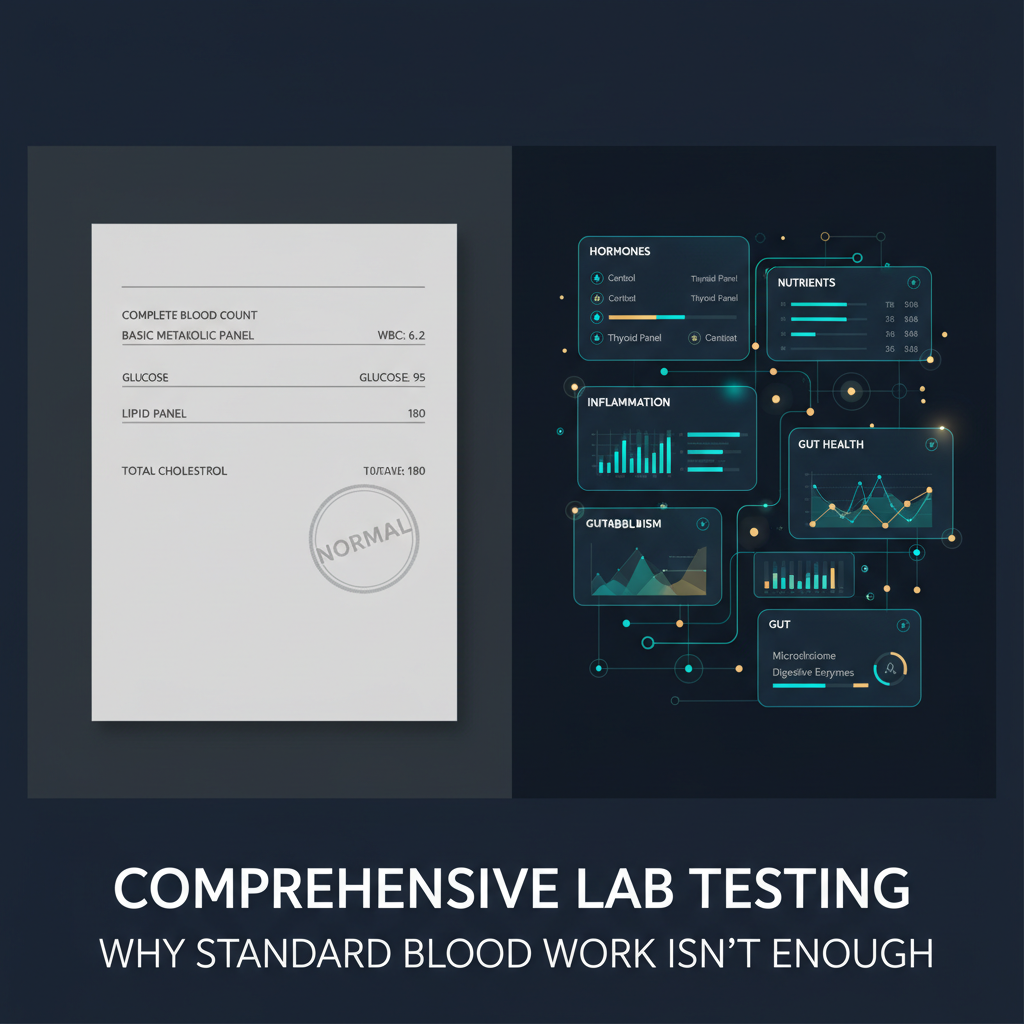
Comprehensive Lab Testing: Why Standard Blood Work Isn’t Enough
Standard blood work is designed to catch obvious disease and dangerous abnormalities—but many people with fatigue, brain fog, weight changes, gut issues, or mood concerns are told “everything looks fine” while their symptoms persist. Comprehensive lab testing takes a deeper, more integrative look at your biology, revealing patterns and early imbalances that basic panels simply are not built to see.
At Prime Vitality Total Wellness and Medical Spa, comprehensive testing is used to guide precise, root-cause plans—not to over-test, but to test smarter when standard blood work and symptoms do not match.(see the generated image above)
What Standard Blood Work Covers—and Misses
Typical “annual labs” often include a complete blood count (CBC), a basic or comprehensive metabolic panel, a simple lipid panel, and sometimes a TSH. These are essential, but they mainly:
- Screen for anemia, infection, kidney and liver disease, and basic electrolyte or glucose issues.
- Offer a broad snapshot of health, not a detailed map of hormonal, metabolic, or inflammatory status.
Articles on advanced bloodwork underscore that while basic panels are a critical starting point, they frequently miss subtle thyroid imbalances, autoimmune activity, chronic inflammation, micronutrient deficiencies, and nuanced cardiometabolic risk.
A useful overview of these limitations is given in Why Basic Bloodwork Isn’t Enough for Complex Symptoms.
What Comprehensive Lab Testing Adds
Comprehensive lab testing builds on standard panels with a more complete view of multiple systems at once.
Common components include:
- Expanded metabolic and cardiometabolic panels: Beyond basic glucose and cholesterol, comprehensive panels may include insulin, hemoglobin A1c, apolipoprotein B, lipoprotein(a), and small dense LDL particles to refine cardiovascular and metabolic risk.
- Full thyroid panel: TSH plus free T4, free T3, and thyroid antibodies, which can detect functional thyroid issues and early autoimmune thyroid disease that a TSH alone can miss.
- Inflammation and oxidative stress markers: High-sensitivity CRP, homocysteine, fibrinogen, and other markers that reflect chronic low-grade inflammation and vascular risk.
- Micronutrient and nutrient panels: Vitamins, minerals, amino acids, and fatty acids that influence energy, mood, immunity, and cellular repair.
Guides to functional lab testing describe these comprehensive panels as the foundation for understanding organ function, immune status, cardiometabolic risk, and nutritional health far beyond a basic screen.
For a structured overview, see A Beginner’s Guide to Functional Medicine Lab Testing.
Why This Matters for Complex Symptoms
For patients with complex or chronic issues, the difference between basic and comprehensive testing can be the difference between “reassurance” and real answers.
Examples:
- Someone with fatigue and hair thinning may have a normal TSH but abnormal free T3 or thyroid antibodies that require different management.
- A person with “normal cholesterol” might still have high ApoB, lipoprotein(a), or small dense LDL that signal elevated cardiovascular risk.
- A patient with brain fog and low mood may show low-normal B12, ferritin, or vitamin D on standard ranges, but comprehensive nutrient panels reveal suboptimal levels contributing to symptoms.
Comprehensive testing also helps personalize interventions—diet changes, supplements, medications, and lifestyle shifts—because care is guided by your biology rather than generic protocols.
Balancing Depth with Responsibility
More testing is not automatically better. Reviews on diagnostic overuse warn that excessive or unfocused testing can increase cost, anxiety, and false positives without improving outcomes. Responsible comprehensive testing is:
- Question-driven: Each test is ordered to answer a specific clinical question or refine a hypothesis, not simply to “run everything.”
- Intervention-linked: Results are used to make concrete treatment decisions—adjusting nutrition, hormones, medications, or follow‑up plans—not just filling a binder with data.
- Time-aware: Panels are repeated strategically to monitor progress and avoid unnecessary repetition.
At a functional and longevity-oriented clinic, this means combining the strengths of standard labs with targeted, higher-resolution testing so that every marker has a purpose in your care plan.
Direction:
If your basic blood work keeps coming back ‘normal’ but you still do not feel like yourself, schedule a comprehensive lab and root-cause evaluation with Dr. Shiv Kumar Goel at Prime Vitality Total Wellness and Medical Spa in San Antonio.” → link to:https://primevitalitycare.com/comprehensive-lab-testing-consultation
Suggested other relevant services at prime vitality:
- Functional medicine & root-cause care:
https://primevitalitycare.com/functional-medicine - Functional medicine testing & advanced panels:
https://primevitalitycare.com/functional-medicine-testing - Hormone and metabolic optimization:
https://primevitalitycare.com/hormone-and-metabolic-testing
Author bio:
Dr. Shiv Kumar Goel is a board-certified internal medicine physician and founder of Prime Vitality Total Wellness and Medical Spa in San Antonio, Texas. He specializes in functional, preventive, and longevity medicine, using comprehensive, targeted lab testing to uncover root causes in metabolic, hormonal, gut, and inflammatory pathways when basic blood work does not explain persistent symptoms.(see the generated image above) Through his practice and writing, Dr. Goel blends modern diagnostics, Eastern wisdom, and AI-assisted analytics to help patients make informed, proactive decisions about their long-term health.(see the generated image above)